Microscoop Reagent Kits

Synlight and Synpull: Chemistry that Brings Nanoscopic Precision to Proteomics

Microscoop’s performance is driven by a suite of reagents designed for precision, reproducibility, and flexibility.

Synlight reagent kits pair with the Microscoop Mint system, combining microscopy-guided two-photon illumination with advanced optics, mechatronics, laser control, and proprietary photolabeling chemistry to achieve unmatched spatial precision. The coordinated performance of these elements ensures that labeling occurs only within defined regions of interest, enabling consistent and reproducible photobiotinylation. When followed by Synpull enrichment kit and mass-spectrometry analysis, the workflow delivers compartmentalized proteomic data – revealing the localized proteins within their true spatial context.

Synpull-enriched proteins are fully compatible with standard LC–MS/MS workflows. This ensures unbiased identification of thousands of proteins — delivering in situ proteome capture preserving native context.

Synlight Portfolio

ENABLING NANOSCOPIC PROTEOMICS

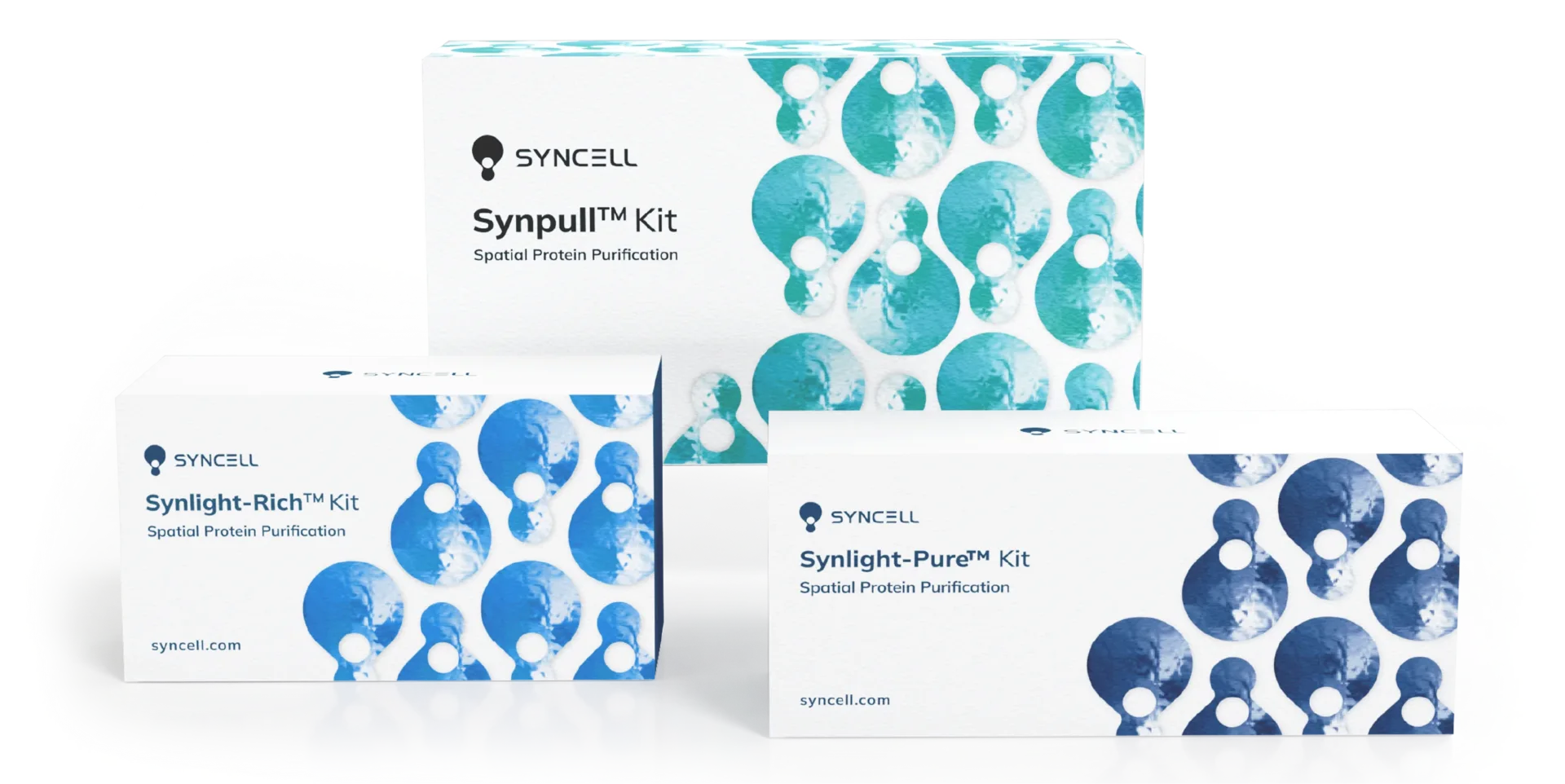
Synlight-Rich

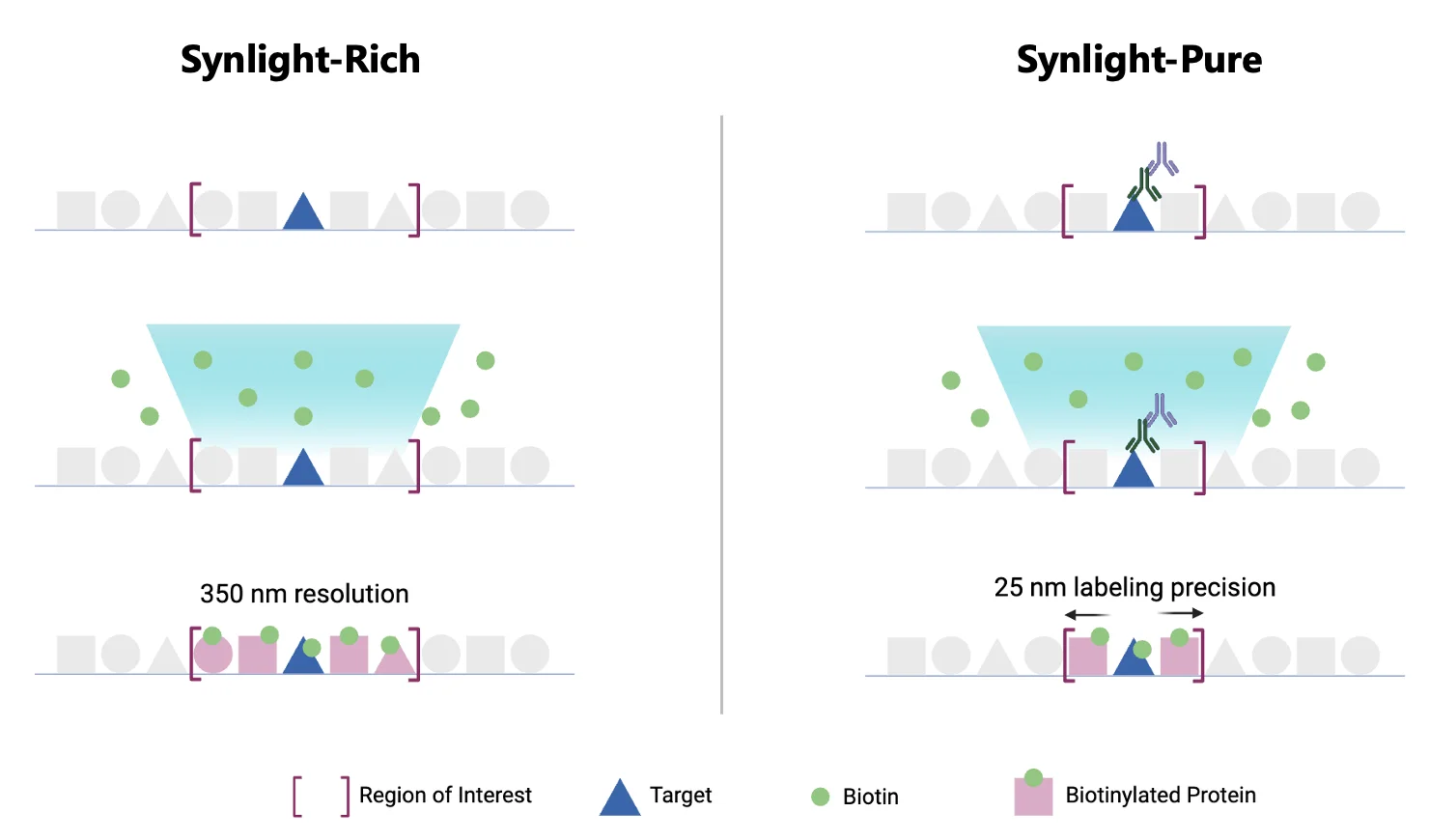
Delivering ~350 nm effective resolution, Synlight Rich is optimized for high-sensitivity unbiased proteome labeling of cells or subcellular compartments at a resolution that is not possible with laser capture microdissection. Synlight-Rich is also ideal for proteomic discovery in a region without any known marker.

Synlight-Pure

With 25 nm labeling precision and an enhanced antibody-mediated reagent set, Synlight-Pure enables finer spatial control – ideal for probing neighborhood proteomes, cell membranes, small organelles, organelle contact sites, and small pathological aggregates. With the addition of Synlight-Pure chemistry, researchers can go beyond the pre-defined resolution of optics and laser control to expand on existing capabilities without the limitations of proximity labeling.

Synlight-Rich

Synlight-Pure

Resolution

~350 nm xy
1.5 μm z

25 nm labeling precision

Core capability

Broad, site-directed photolabeling for unbiased discovery
Targeted precision, antibody mediated proximity photolabeling for nanoscale discovery

Applications

Whole Cell Proteome, Cell-Cell Interactions, Larger Compartments/Organelles, Target Free Proteomics

Smaller Compartments/Organelles, Protein-Protein Interactions, Protein Complex Mapping, Microdomain Proteomics, Inter-Organelle Proteomics

If you’re struggling with:

Laser Microdissection
Targeted Methods

Proximity Labeling

Unsure which Synlight kit fits your experiment? ​

Choose Synlight-Rich for broad discovery and hypothesis generation.
Choose Synlight-Pure for fine-scale discovery and mechanistic studies.

Rich

Resolution

~350 nm xy
1.5 μm z

Core capability

Broad, site-directed photolabeling for unbiased discovery

Applications

Whole Cell Proteome, Cell-Cell Interactions, Larger Compartments/Organelles, Target Free Proteomics

If you’re struggling with:

Laser Microdissection
Targeted Methods

Unsure which Synlight kit fits your experiment? ​

Choose Synlight-Rich for broad discovery and hypothesis generation.

Pure

Resolution

25 nm labeling precision

Core capability

Targeted precision, antibody mediated proximity photolabeling for nanoscale discovery

Applications

Smaller Compartments/Organelles, Protein-Protein Interactions, Protein Complex Mapping, Microdomain Proteomics, Inter-Organelle Proteomics

If you’re struggling with:

Proximity Labeling

Unsure which Synlight kit fits your experiment? ​

Choose Synlight-Pure for fine-scale discovery and mechanistic studies.

Need help deciding which kit is best for your experiment?

Synpull

Following photolabeling, Synpull is purpose-built enrichment kit for high-efficiency recovery of biotinylated proteins using the Microscoop Mint. Its optimized chemistry ensures clean enrichment and compatibility with bottom-up proteomic analysis using LC-MS/MS.

Together, Synlight and Synpull reagent kits create the bridge from imaging to proteomic data. Researchers can tailor their workflows for resolution where it matters most, without compromising breadth of discovery.

NEW PUBLICATION

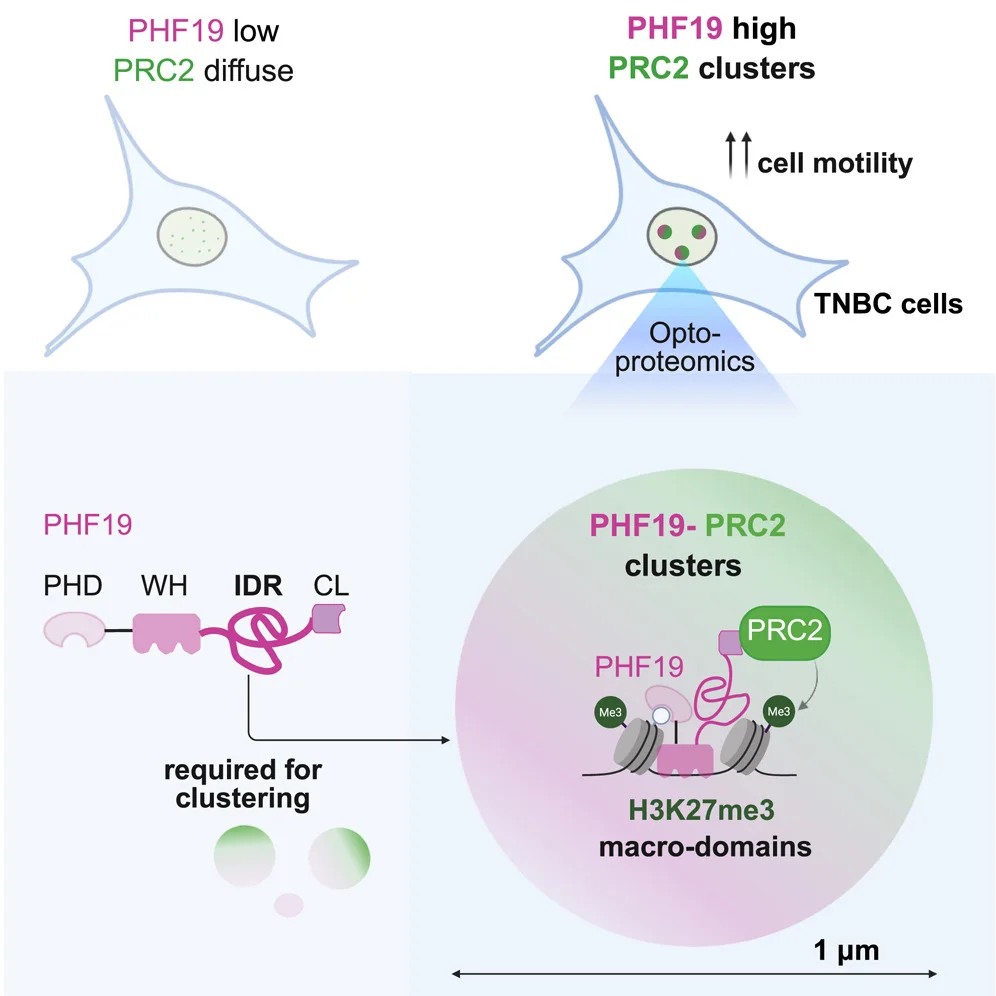
PHF19 drives the formation of PRC2 clusters to enhance motility in TNBC cells

Pelzer, Nina et al.
Cell Reports, Volume 44, Issue 10, 116391